
A useful LIVE hook tells a new viewer what is happening, why it matters, and what they can see next. It can create the conditions for voluntary support, but no opening line guarantees Gifts. Deliver the promised content before making a brief optional invitation.
TikTok — LIVE Monetization Guidelines.
Build the hook around a real payoff
Choose an outcome the room can actually observe: a repaired mistake, a finished sketch, a useful comparison, a clear answer, or a performance. A hook is a promise about attention, not an instruction to spend.
Keep the promise small enough to deliver during the session. “Watch me solve this specific problem” is easier to evaluate than “stay and your life will change.” If the promised result never appears, a more dramatic opening only makes the mismatch worse.
New viewers can arrive at any moment, so prepare a short truthful reset. Restate the current task and progress without restarting the entire broadcast or pretending each arrival is the final chance to participate.
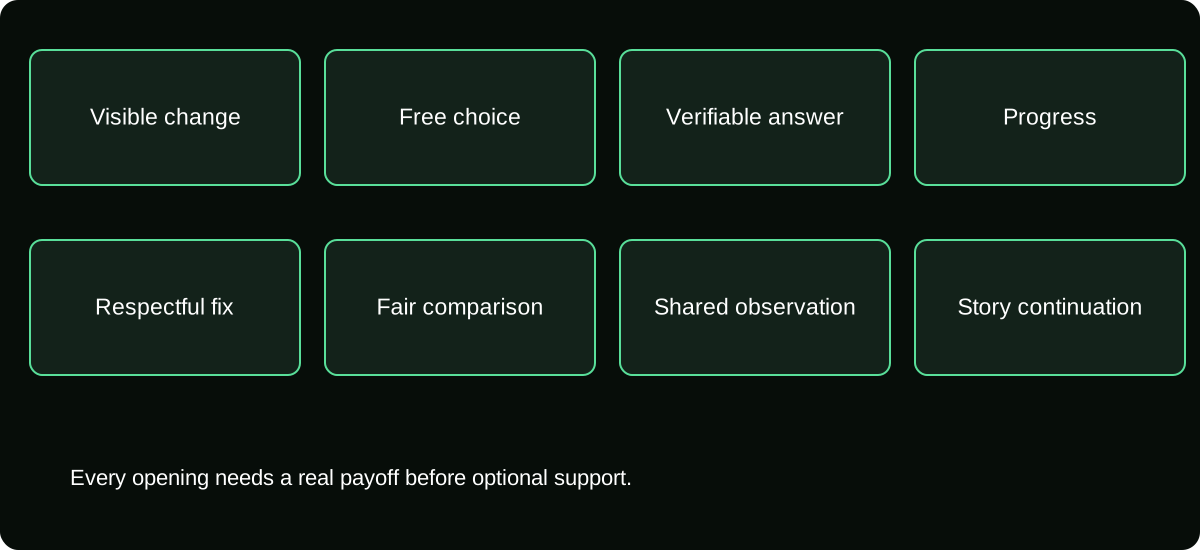
Hook 1: show the problem and the next visible change
Example: “This drawing feels flat. I am changing only the light direction so you can see what makes it read differently.” Show the starting state and make the change visible.
This works as a useful demonstration because viewers can judge the result. Do not secretly change several variables and attribute the improvement to one technique. Optional support can follow the completed teaching moment rather than interrupting it.
Hook 2: offer a free choice with a bounded result
Example: “Choose the blue or green version in ordinary comments; I will build the selected version next.” Keep participation available without Gifts and explain how you will make the choice.
Avoid presenting this as a paid contest or a chance-based reward. The value is seeing audience input shape the content, not selling viewers an uncertain prize or suggesting that larger spending proves a better opinion.
Hook 3: answer a question people can verify
Example: “Here is how I tell whether this sound problem is the microphone or the room. I will compare both tests.” State what evidence will distinguish the causes.
Viewers get a method they can use themselves. Do not substitute an unsupported claim of expertise for the promised comparison. The same structure suits art, software, craft, and other topics when the explanation stays within your actual competence.
Hook 4: start a short process with visible progress
Example: “We are turning this rough idea into a three-panel scene. The first panel is finished; now we need the turning point.” Display the progress so late arrivals understand the task.
Break the work into meaningful stages instead of arbitrary delays. If you mention support, keep the project honest about whether the current stage continues regardless. Do not invent a paywall after promising a public demonstration.
Hook 5: correct a common mistake respectfully
Example: “This edit looks smooth but hides the important action. I will change one cut so the scene makes sense.” Show the before-and-after result and explain the reason.
Critique the work rather than humiliating a person. Use material you may show and avoid exposing a viewer's private submission without permission. A respectful correction builds a different room from a performance based on public embarrassment.
Hook 6: compare two legitimate options
Example: “These two setups solve the same task differently. I will compare the result and the work needed to change it.” Define the task before naming a winner.
Separate sponsorship or affiliate relationships where relevant. A comparison that quietly changes the criteria to favor a paid partner can damage trust even if it produces short-term engagement. Do not promise viewers earnings or guaranteed outcomes from the selected option.
Hook 7: create a shared observation
Example: “Listen for the difference after this small adjustment. Tell me what changed before I explain it.” Give viewers time to notice and use ordinary comments to participate.
The observation needs to be real and audible or visible through the stream. A tiny difference that is lost in compression is not a fair test. Check your output so the audience can access the experience you promised.
Hook 8: continue a story with a clear recap
Example: “Yesterday the character found the key. Today we need to decide why she does not use it.” Give enough context for a new viewer, then deliver the current creative choice.
This can support recurring sessions without making newcomers feel excluded. Do not claim the recap is a real crisis or personal emergency if it is fictional. The attraction is the ongoing process and its meaningful development.
Place the support invitation after value has landed
Use one short, accurate explanation of optional Gifts at a suitable transition. Keep the content promise and the payment feature separate. Someone should be able to enjoy the demonstrated value without being pressured into a transaction.
Acknowledgement should not erase the room's other participants. Thank people naturally, then return to the content. If the entire session becomes a spending leaderboard, you may attract a different audience from the one the hook originally promised.
Review TikTok's current LIVE monetization and Gift-baiting rules. Fake urgency, humiliating viewers, misleading rewards, or pressure should not be presented as growth techniques merely because they can provoke reactions.
Test hooks without claiming a causal miracle
Record the hook, topic, session length, traffic context, and available retention or participation measures. Compare similar broadcasts rather than one quiet session with one unusually large audience.
Track voluntary support alongside the viewing experience. More Gifts accompanied by worse retention, complaints, or high dependence on one sender does not establish a healthier format. Use your actual reward and payout records for income analysis.
Change one meaningful element at a time where practical. If the topic, schedule, host, and invitation all change, you cannot attribute the outcome to the opening line. A hook is a testable editorial choice, not a guaranteed revenue formula.
Give the hook an exit condition
For each opening, write what counts as fulfilling it. A comparison ends when both relevant options have been shown; a correction ends when the audience can see the repaired result. That prevents the hook from becoming an endless teaser whose payoff is always postponed.
If the planned demonstration fails, explain the limitation honestly and show the next useful step. Do not invent success to preserve the opening line or turn the failed test into a demand for Gifts. A transparent attempt can still provide value, especially when viewers learn why the result did not support the original claim.
Frequently asked questions
Can a hook use a viewer’s submitted work as the demonstration?
Obtain the permission needed to display the work and any personal details it contains. An engaging correction should not surprise a viewer by exposing a private submission to the room.
Can an on-screen title replace a spoken hook?
It can help orientation, but verify that it is readable on a phone and agrees with what the stream actually delivers. Spoken context and visible progress can complement it.
What if I cannot deliver the promised demonstration because equipment fails?
Explain the failure and offer a useful next step or a revised plan. Do not pretend the result occurred or ask viewers to pay to repair a promise that was originally offered publicly.