
The official material reviewed does not establish one fixed creator percentage of every viewer’s Coin purchase. Use your actual reward and payout records, and define the denominator before calculating an effective percentage. A retail Coin price alone cannot prove the creator’s share.
TikTok Virtual Items Policy — United States.
Ask what the percentage is a percentage of
A headline such as “creators keep half” leaves the denominator unclear. It could refer to the viewer's final checkout charge, an assumed base Coin price, a Gift's quantity label, a reward amount, or proceeds after payment fees.
Those values are not interchangeable. A viewer's app-store purchase price can differ from a web quote, and the creator may never see either individual receipt. A Gift's Coin requirement is also not an ordinary-currency sale price delivered directly to the creator.
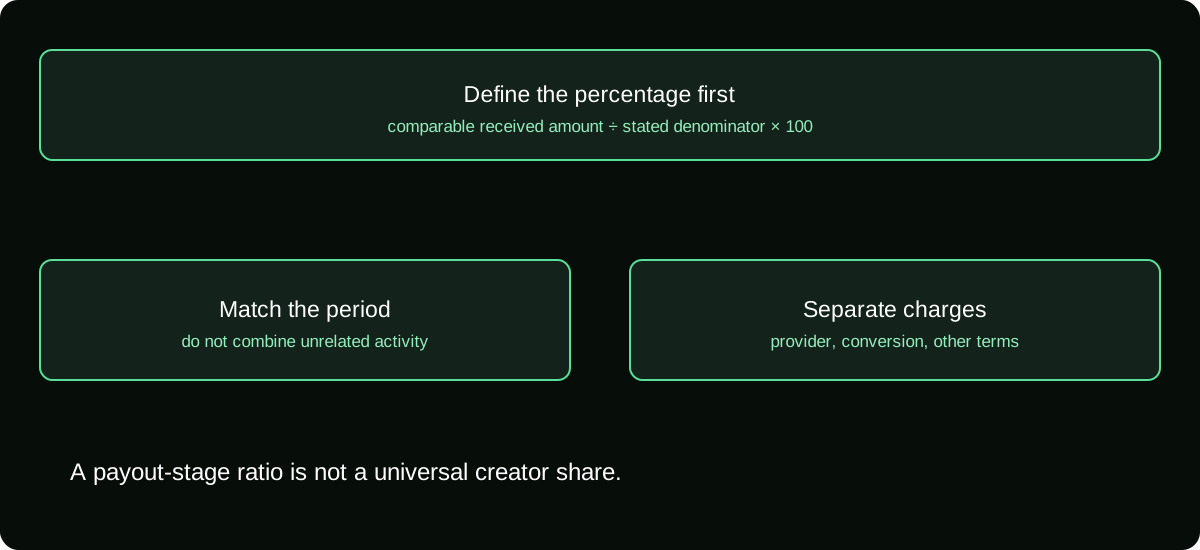
Before using any number, state its units and stage. “Cash received divided by matched viewer spending” is a different measure from “payout after fees divided by the reward amount requested.” Both may be calculated in a documented case, but neither should silently replace the other.
Map the stages where values can differ
| Stage | Relevant evidence | Comparison risk |
|---|---|---|
| Viewer buys Coins | Actual receipt and quantity | Different packages and channels |
| Viewer uses a Gift | Coin charge and usage | Not a direct cash transfer |
| Creator reward is recorded | Own program statement | Recognition and reward treatment |
| Creator requests payout | Amount, currency, disclosed terms | Not yet a completed receipt |
| Provider delivers funds | Actual transaction | Fees and conversion |
Calling the difference between the first and last row “TikTok's commission” can misattribute charges or assumptions from other stages. Identify each component before assigning a party or rate.
The useful analysis preserves the unknowns rather than treating them as proof of a hidden universal formula.
Distinguish published terms from common estimates
Search results contain confident ratios and different Coin-to-Diamond assumptions. Agreement among copied calculators is not the same as an official account-specific promise.
TikTok's Virtual Items Policies and Diamonds help describe different roles for virtual items and creator rewards. Use the applicable program and your actual payout screen for monetary entitlement. Do not turn a familiar online estimate into a guaranteed amount for every market or campaign.
If you report an estimate, identify it as such, state its source and date, and show the inputs. Readers should be able to tell whether the calculation is documented policy, a single observed case, or an unverified convention.
Calculate an effective payout measure when the evidence supports it
For a payout-level audit, use:
effective delivery percentage = amount received, on a comparable basis ÷ reward amount requested × 100
This measures the payout stage, not the platform's share of a viewer's retail spending. You need matching currencies or actual conversion evidence and a way to identify the relevant charges.
If you want an effective viewer-to-creator return for a specific case, you also need legitimately obtained, matched viewer spending data and the corresponding creator result. That information is often unavailable. Do not invent the denominator from a generic package price.
Where matching fails, the correct output is “not established from these records.” That is a useful conclusion because it prevents an exact-looking percentage from being used to set income expectations.
Avoid common denominator errors
Do not use the full cost of a Coin package if only part of it funded the observed interaction without explaining how you allocated cost. Do not count unused purchased Coins as money already associated with the creator.
Do not compare a creator payment covering many sessions with one sender's Gift. A period mismatch can make the percentage exceed or fall below any sensible range while the underlying records are each correct.
Do not mix gross reward, net provider receipt, and net business profit. Production expenses and taxes may affect your own economics, but they are not automatically part of the platform's reward calculation or payment fee.
Document an observed case without claiming a global rule
Record account market, program, relevant period, original currencies, quantity measures, monetary records, and any known adjustments. Remove private details from examples shared publicly.
Explain what you could not observe. For example, you may know the amount received but not the viewer's acquisition cost or the program's internal calculation. The report can still describe the payout-stage difference without pretending to explain the complete system.
Avoid giving a future guarantee from a past case. Terms, payment methods, location, and account conditions can change. A verified observation tells readers what happened within its scope, not what every creator will receive next month.
Make support questions specific
If a payout differs from the request, ask about that payment and any disclosed deduction. If a reward statement differs from a session estimate, ask about the reporting period and calculation source. If Gift activity is missing, identify the session event.
This is more effective than asking support to restore a conventional percentage the account terms never promised. Use the labels shown in the records and retain the response as part of the ledger.
Do not expose viewers' receipts or payment details in public as a way to pressure a resolution. The relevant platform or provider can investigate through authorized channels without publishing private financial information.
Plan creator income using actual results
For your own business decisions, track reward statements, real payouts, costs, and time across multiple sessions. Use consistent definitions before comparing performance.
If the purpose is deciding whether streaming is financially worthwhile, a measured effective return and net operating result are more helpful than a universal commission headline. They show your own outcome without claiming access to an undisclosed worldwide formula.
For viewers, budget the amount you are comfortable spending rather than assuming a Gift delivers a guaranteed fraction to the creator. For creators, avoid promising senders an exact conversion unless the applicable official program actually establishes it for that action.
Ask for the definition behind a reported percentage
When a service, agency, or calculator supplies a share figure, request the written calculation base. Is it before or after provider fees, based on an estimated reward, or tied to actual collected funds? Ask which period and currency the statement covers and what adjustments can change it.
A clear answer may let you evaluate that specific offer even when the wider platform formula remains unavailable. An unclear answer should remain a limitation in your analysis. Do not average several incompatible percentages merely to produce a single number for a site headline.
Frequently asked questions
Can a creator’s agency change the amount they finally keep?
An agency arrangement can have its own terms, separate from platform rewards and payment-provider charges. Review the actual agreement and do not describe every deduction as TikTok’s share.
What if a percentage changes only because the currencies differ?
Return to the original amounts and the actual conversion record. A ratio combining unmatched currencies has no clear meaning until a documented common basis is established.
Can a negotiated service fee be compared with a public calculator’s rate?
Only after aligning the calculation base, period, and included charges. A contract tied to collected funds is not automatically comparable with a calculator based on a hypothetical viewer package.
Sources and scope
- TikTok Virtual Items Policy — United States
- TikTok Virtual Items Policy — rest-of-world scope stated on the page
- TikTok Help — Diamonds and LIVE rewards
- Payoneer — TikTok LIVE creators FAQ; provider-specific timing and fees