
TikTok-related creator receipts can create tax obligations; calling the platform feature a “Gift” does not establish that the income is tax-free. Identify your tax jurisdiction and activity, preserve reward and payment records, and apply that jurisdiction’s rules rather than a worldwide Coin tax rate.
U.S. IRS — Gig Economy Tax Center.
Start with residence, activity, and the relevant tax year
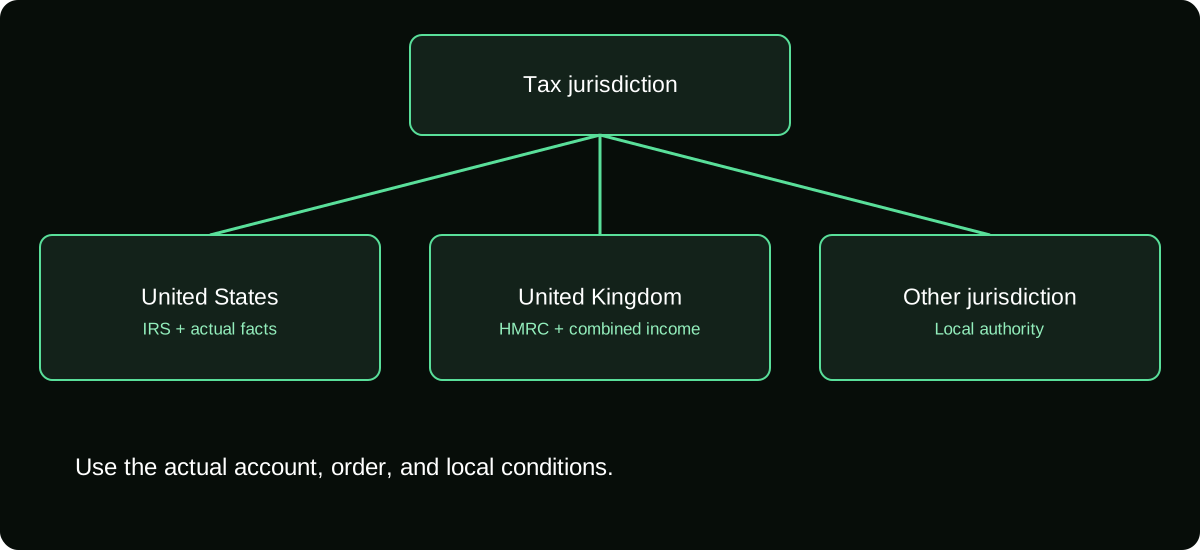
This guide provides a recordkeeping framework and scoped U.S. and U.K. examples. It does not determine the tax treatment of every creator worldwide. The country shown on a payment screen, currency received, and location of viewers do not by themselves settle tax residence.
Identify where you are required to report, whether you operate individually or through an entity, and what other related income you have. A move between countries or cross-border payment can add questions that a platform dashboard cannot answer.
Use the tax year applicable to the jurisdiction, not automatically a calendar year. Retain transaction dates and the original records so an adviser can assess the correct period without relying on a monthly Coin conversion estimate.
Do not let the word Gift decide the classification
An in-platform Gift is a virtual-item interaction under TikTok's terms. A creator's resulting reward payment may be linked to content activity. That does not automatically make it a personal, non-taxable gift under local tax law.
Describe the underlying facts: what you created, how rewards arose, whether the activity is ongoing, what contractual or program terms apply, and what was received. These facts are more relevant than changing the spreadsheet label to “donation.”
Similarly, a supporter calling a payment a present does not resolve the treatment of revenue connected to a business or creative activity. Seek qualified advice when classification materially affects your return.
U.S. example: a form threshold is not a blanket exemption
The IRS Gig Economy Tax Center states that income from gig activity is taxable and must be reported even when it is part-time, not shown on an information return, or paid in forms other than ordinary cash. Apply that guidance to your actual activity and circumstances.
Do not assume that receiving no tax form means no obligation, or that a platform's reporting threshold is a universal tax-free allowance. The information-reporting duty of a payer and your own reporting duty are different questions.
Classification, deductions, self-employment treatment, state or local obligations, and estimated payments require case-specific review. This article does not calculate a U.S. rate from the number of Coins viewers used. Preserve the actual creator reward and payment records instead.
U.K. example: examine combined activity, not only TikTok
HMRC's guidance on online-platform income specifically includes creating online content and explains that related trading income may need to be combined with other trading activity. It discusses the £1,000 trading allowance as part of deciding when to tell HMRC.
That is not a statement that every creator has a separate £1,000 allowance for each platform or that reporting and tax payable are identical. The applicable conditions, total activity, and tax year matter.
HMRC also addresses gifts or services received from promoting products. Keep those sponsorship or promotional benefits separate from TikTok virtual-item terminology, then provide the facts needed for proper valuation and classification. Do not merge every item called a gift into one undifferentiated category.
Capture the original financial evidence
| Record | Why it matters |
|---|---|
| Reward statement | Shows the platform's amount, label, period, and status |
| Payout request | Identifies what was requested and when |
| Provider receipt | Shows the actual payment currency and any disclosed charges |
| Bank receipt | Helps trace final receipt and conversion |
| Adjustments or reversals | Explains changes rather than silently deleting them |
| Expense evidence | Supports review of costs under applicable rules |
Keep these records even if you prepare a simpler summary. A bank total alone may not explain gross reward, provider charges, currency conversion, or the period to which a payout relates.
Avoid recording the same amount again when it moves from available reward to payout request to bank receipt. These can be stages of one transaction, not three independent earnings events.
Separate gross amounts, costs, and deductions
List production and payment costs with dates, business purpose, and receipts. Equipment, software, moderation, or provider charges should not be assumed deductible merely because they relate loosely to social media.
Your jurisdiction and facts determine whether a cost is deductible, partly allowable, capital, personal, or treated another way. Keep mixed personal and creative use visible for review rather than assigning all spending to the activity.
Do not deduct the viewer's Coin purchase price from your creator income unless it is actually your cost under an applicable rule. A viewer's spending is not automatically an expense incurred by you. Likewise, keep withholding separately identified instead of relabelling it as a platform commission.
Preserve currency and timing before producing a tax summary
Retain each original currency and the conversion evidence available. The amount on the payout screen and the bank receipt may differ because of execution timing or provider treatment. A generic internet rate selected later may not be the required reporting basis.
Do not assume that moving funds between your own payment accounts creates new income, or that leaving a reward in the app postpones tax automatically. Recognition timing depends on the applicable accounting and tax rules.
Provide an adviser with statements, payout status, and receipt dates so they can assess that issue. A calculator assigning cash value to a Diamond balance is not a substitute for the records needed to determine taxable amounts.
Prepare a focused review with an adviser or official tool
Bring your jurisdiction and entity information, tax year, related income, creator program terms, gross and net records, adjustments, currency details, and expense evidence. Identify any unresolved gap explicitly.
For the U.K., HMRC provides an online additional-income checking tool and platform-income guidance. For the U.S., use the IRS's current material and the requirements relevant to your activity. For other countries, begin with the local tax authority and a qualified practitioner where needed.
Do not send tax identifiers or documents to an account that approaches you in LIVE chat claiming to collect a withdrawal tax. Verify any legitimate platform tax-information request through the signed-in account and actual provider.
The objective is an accurate return based on real creator income and the correct jurisdiction. A Coin count, a missing information form, or the label Gift cannot do that legal and accounting work alone.
Frequently asked questions
What if I move countries during the year I receive rewards?
Preserve the relevant dates, activity, and payment records and obtain advice about residence and cross-border obligations. Do not assign the entire year using only the country selected in the payout account.
Should I wait until a dispute is resolved before saving records?
Save the original entries and the eventual outcome. Adjustments and reversals can matter, and deleting the initial evidence makes later review harder.
Does paying someone else to edit the LIVE automatically make the cost deductible?
No automatic treatment follows from the payment alone. Preserve the agreement, business purpose, and receipt, then apply the relevant local rules to the actual expense.
Sources and scope
- U.S. IRS — Gig Economy Tax Center
- U.K. HMRC — income from online platforms and content creation
- U.K. HMRC — additional-income checking tool